
Key points
- In its U.S. scope, OSHA 29 CFR 1910.147 covers servicing where unexpected startup or stored energy may injure workers.
- The standard distinguishes physical energy-isolating devices from push buttons and control-circuit switches.
- A maintenance brief should identify isolation points, residual energy, verification, training and handover.
A stop button is not an isolation plan. Equipment briefs should identify each energy source, who controls it and how a safe maintenance handover is verified.
Start with the regulatory scope
OSHA’s U.S. general-industry standard 29 CFR 1910.147 covers servicing and maintenance when unexpected energization, startup or release of stored energy could injure workers. It requires an energy-control programme with procedures, training and periodic inspection within its scope. This is a U.S. reference for project discussion, not a certification of Zhengye equipment or a statement of law in every country.
Distinguish stop from isolation
The regulation defines an energy-isolating device as one that physically prevents transmission or release of energy, and explicitly excludes push buttons and other control-circuit devices. On a slaughter line drawing, label electrical, pneumatic, hydraulic and mechanical sources and the corresponding accessible isolation points. A red emergency-stop button may stop motion but should not be presented as the sole maintenance isolation method.
Plan stored-energy verification
The source requires potentially hazardous residual energy to be relieved, disconnected, restrained or made safe, and isolation to be verified before work. For each machine, ask the supplier and operator to identify moving parts, pressure, gravity loads and connected equipment requiring attention. Document the sequence, qualified role and test without publishing a generic procedure as if it fitted every installation.
Make maintenance handover traceable
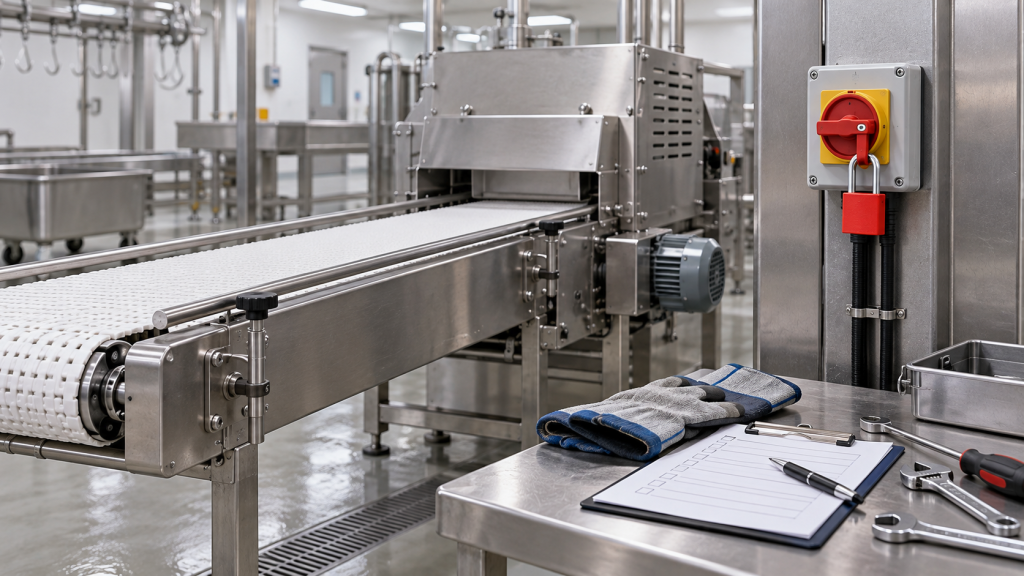
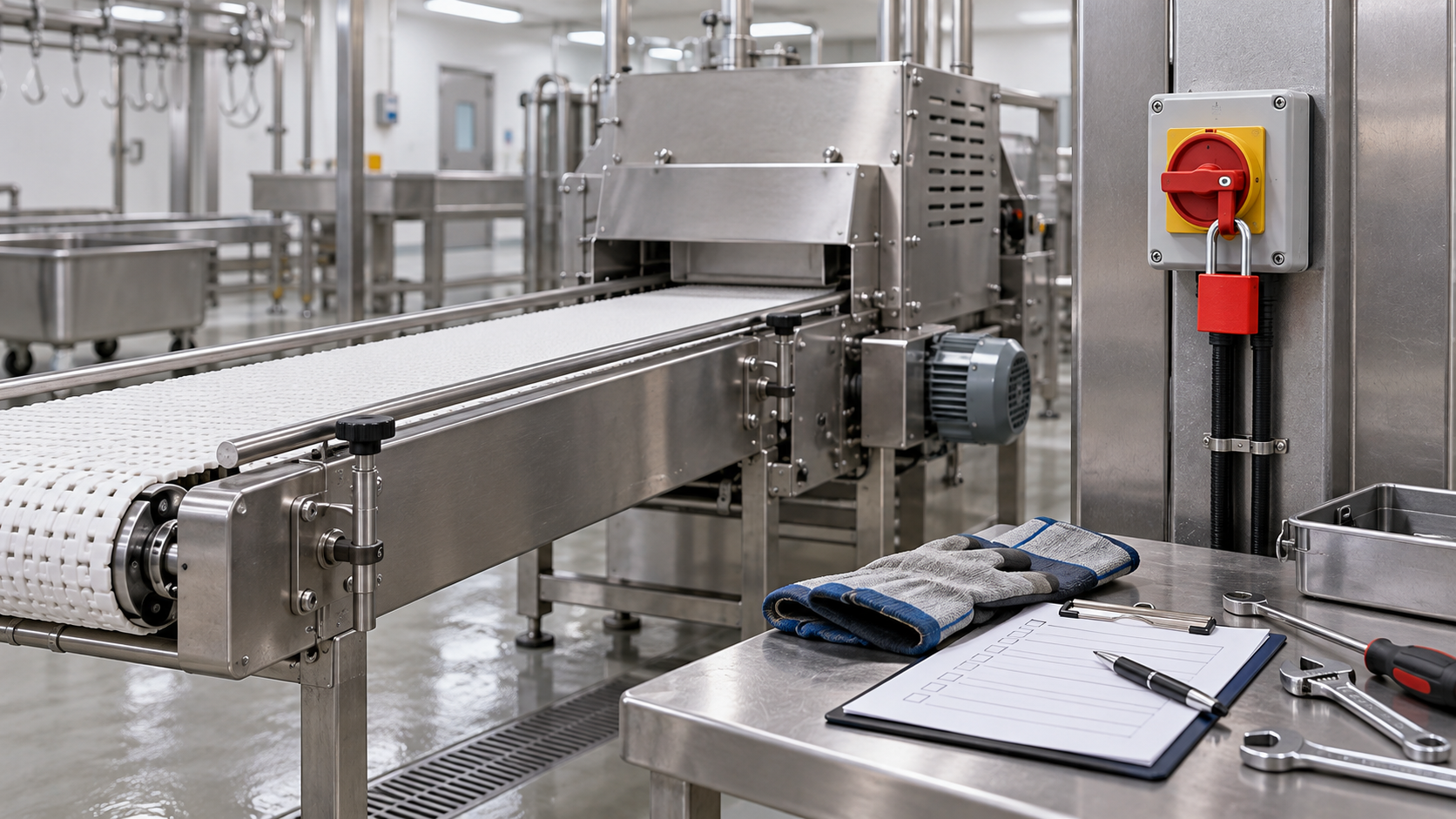
A practical record links the machine, authorized worker, isolation devices, work start, verification, handover and controlled return to service. Align drawings with the operator’s site procedure and local authority requirements before commissioning. Source checked on 14 October 2026. The generated cover is illustrative and does not depict a tested safety system.
Practical question
Is an emergency-stop button a lockout point for maintenance?
No. OSHA distinguishes control-circuit buttons from devices that physically isolate energy. Use the site-specific energy-control procedure and verify isolation.
Related equipment and planning resources
Sources and further reading
Sources checked: