Halal Slaughtering Requirements | Equipment and Layout
Halal Slaughtering Requirements for Equipment and Abattoir Layout
Halal slaughtering requirements become practical only when the building, equipment, personnel flow and records support the approved method. A line should make the correct procedure repeatable at normal production speed, not depend on a temporary workaround.
Zhengye designs cattle, sheep and goat equipment around the buyer’s certification scope: restraint access, bleeding, knife control, hygiene separation, product identification, rails and documentation. Final religious acceptance remains with the recognized authority.
From Requirement to Physical Control
A written requirement may say that an authorized person must perform slaughter, that the animal must be restrained correctly, that a suitable knife must be used or that bleeding must be verified. The equipment designer must translate each statement into a location, access route, tool, control point or record. If that translation is missing, the plant discovers the problem only after the line is built or audited.
The most valuable planning exercise is to walk through the line as an operator. Who enters the slaughter area? Where is the spare knife? How is a contaminated knife replaced? Where can a supervisor verify bleeding? How does a carcass keep its identity? Which route do hides, offal and waste take? These answers should appear in the layout before equipment is ordered.
Main Equipment Areas That Affect Compliance
Restraint and access
Race, head restraint, rotary box or cradle designed for the approved method and animal size.
Knife and hand hygiene
Sterilizers, spare knives, wash points and controlled cleaning at the slaughter position.
Bleeding rail
Enough time and uninterrupted travel for the required bleeding interval before dressing.
Dressing stations
Platforms, skinning or hide equipment, evisceration pans and tool control that limit cross-contact.
Inspection and identity
Visible identification of approved, rejected and held product through the line.
Cleaning and records
Cleanable surfaces, drainage, maintenance access and documents that match actual operations.
Layout Rules for Halal and Hygienic Operation
- Keep live animals away from finished product
- Separate clean and dirty dressing operations
- Locate knife sterilization at the slaughter position
- Keep spare knives clean and controlled
- Provide uninterrupted bleeding rail length
- Prevent hide, skin and offal contact with carcasses
- Control floor splash and condensation
- Make product identification visible at transfer points
- Provide a separate route for condemned material
- Allow cleaning access around equipment and rails
- Protect electrical panels from washdown water
- Keep authorized personnel access under control
Restraint and Slaughter Position
The restraint system should position the animal safely and consistently for the authorized person. Cattle may require heavier head restraint or a rotary box; sheep and goats may use a cradle or V-restraint. Whichever system is selected, the worker should be able to reach the required area without awkward stretching, obstruction or delay. The animal should not be exposed to unnecessary stress while the operator prepares.
Where direction or orientation matters, the layout should make it natural. The restraint, platform, rail and worker position should be coordinated. A requirement that depends on the operator turning around or working across a rail can be difficult to repeat on every shift.
Knife, Tool and Hand Hygiene
The slaughter position should have a practical knife sterilization point, spare knives and a clear rule for replacement after contamination. Hand-wash and apron-cleaning points should be placed where the worker changes task, not only at the entrance to the room. Tool hygiene should be designed for the actual sequence of slaughter and dressing.
Equipment should be cleanable without disconnecting the line for long periods. Smooth surfaces, radiused corners, drainage and removable guards help. Cleaning instructions should identify what is cleaned after each animal, each batch, each shift and during periodic maintenance. The certification authority may ask to see how these procedures are verified.
Bleeding and Dressing Separation
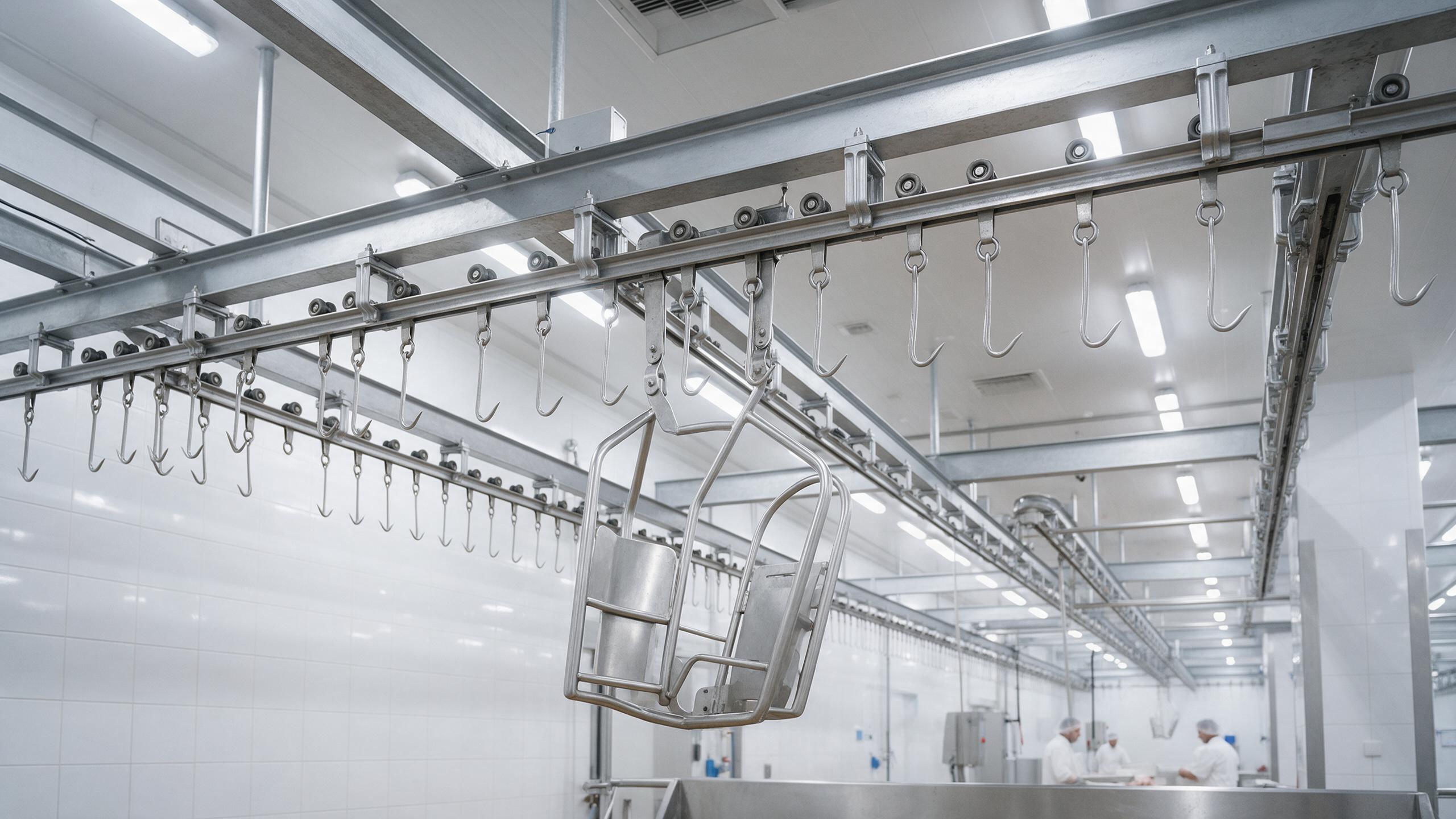
The bleeding rail connects the religious procedure to the hygienic dressing process. It should provide enough time for the required interval and prevent dressing from starting early. The discharge point should be controlled so blood and dirty water do not reach edible product or clean equipment.
Dressing should begin after the responsible person has verified the condition and interval. Hides, skins, heads, hooves and digestive contents should move away from the carcass route. If the building cannot provide complete separation, a written procedure, physical barrier or validated cleaning step may be required, but these should be reviewed with the authority rather than assumed acceptable.
| Control point | Equipment implication | Record or procedure |
|---|---|---|
| Authorized slaughter | Controlled access and safe working position | Personnel authorization and shift record |
| Knife hygiene | Sterilizer and spare-knife location | Sharpness, cleaning and replacement check |
| Bleeding interval | Rail length and line speed | Verification before dressing |
| Product identity | Tags, hooks, trays or electronic system | Traceability through inspection and chilling |
| Clean and dirty separation | Paths, walls, drainage and equipment placement | Cleaning and cross-contact control |
| Maintenance | Accessible components and spare parts | Preventive maintenance and fault records |
Species-Specific Considerations
Cattle
Cattle lines require heavy restraint, safe access and substantial hide handling. The slaughter position should be designed around animal size and the accepted method. Hide removal is a major contamination source, so the path from the hide puller to the hide exit should not cross clean carcass surfaces. The halal cattle slaughter line page covers the full process.
Sheep and Goats
Sheep and goat lines can be compact, but the smaller scale can hide problems. Worker reach, rail height, skinning access and product identification still need to be designed. Seasonal Qurban peaks may require additional restraint, bleeding and chilling capacity without changing the approved procedure. See the halal sheep and goat line.
Documentation That Matches the Line
The plant should avoid copying generic forms from another facility. Records should match the actual stations and responsibilities. Useful documents may include process flow, general arrangement, equipment list, cleaning instructions, training records, maintenance logs, traceability forms, stunning parameters if applicable, and corrective-action records.
Equipment drawings should show where the slaughter position, bleeding rail, knife sterilizer, wash point, product identification and waste routes are located. If the plant later changes these, the technical file and process description should be updated. A controlled revision process prevents the builder and the authority from reviewing different layouts.
Common Design Failures
Remote knife station
The operator cannot sterilize or replace a knife without leaving the animal or delaying the procedure.
Short bleeding rail
Line speed forces dressing before the required interval is complete.
Crossing waste route
Hides, skins or offal cross the clean carcass path, creating a contamination risk.
Poor identity control
Carcass and offal lose their link during transfer to inspection or chilling.
Generic records
Forms do not match the equipment or the actual production flow.
No maintenance access
Equipment cannot be cleaned or repaired without crossing hygienic boundaries.
Frequently Asked Questions
Can equipment alone make a plant halal compliant?
No. The plant must control personnel, method, hygiene, records and product identity. Equipment can support those controls but does not grant certification.
Does every halal plant need the same layout?
No. Species, capacity, building form and the certification authority can change the layout. The principles of separation and control remain, but the details should be reviewed locally.
Where should a knife sterilizer be located?
As close as practical to the slaughter position so the operator can maintain tool hygiene without disrupting the procedure. The exact configuration should match the approved workflow.
Can a conventional line be upgraded?
Often it can, but the restraint, slaughter access, bleeding, separation, cleaning and documentation must be assessed. A new procedure may not solve a poorly separated building.
What should be included in the technical brief?
Species, capacity, authority, slaughter method, building dimensions, utilities, product output and any required documentation language. These inputs drive the rest of the design.
Turn religious and audit requirements into a buildable line
Share the authority, species, capacity and floor plan. We will identify the equipment and layout questions that need approval before fabrication.