Technical Halal Slaughter Guide | Cattle, Sheep and Goats
Halal Slaughter Guide for Cattle and Sheep Abattoirs
This guide explains the equipment, layout and recordkeeping issues that commonly arise when a cattle or sheep plant prepares for halal slaughter. It is written for project owners, process engineers and equipment buyers who need to translate religious requirements into a workable facility.
It is not a fatwa and does not replace the decision of a recognized religious authority. Requirements can vary by country, certifier and current standard. Confirm the exact method with the authority that will audit your plant.
The Purpose of a Technical Halal Guide
Religious requirements are normally expressed through rules and standards, while a slaughterhouse is built from physical spaces, equipment, labor and records. The project challenge is to make those two worlds consistent. A slaughterman must have safe access. An animal must be restrained without unnecessary injury. The bleeding rail must allow enough time. Knives, wash stations, carcass identification and waste routes must be arranged so that the approved process can be repeated at normal operating speed.
A technical guide is useful because it turns broad requirements into questions a designer can answer. Where does the animal stand? What direction does it face if direction is required? Who can enter the slaughter area? Where is the knife cleaned? How is bleeding verified? How does an approved carcass keep its identity through evisceration, splitting and chilling? These questions should be resolved before equipment fabrication.
Basic Process Sequence
The physical sequence is similar to a conventional line, but the front end and control points are not interchangeable. Restraint, the slaughter position, the slaughterman’s access, bleeding time and segregation determine whether the approved procedure can be followed. The equipment should make the correct sequence the normal sequence, not an exception that depends on one experienced operator.
Animal Eligibility and Welfare
The plant should have a clear procedure for receiving animals, checking identity, observing health and welfare, and preventing animals that are not eligible from entering the line. Ante-mortem inspection is important for both food safety and operational control. An animal that is injured, stressed, sick or otherwise unsuitable should not be forced through a restraint system that was designed for normal, healthy animals.
Good handling reduces risk at the slaughter position. The race, forcing pen, restraint and floor should be designed to keep animals moving forward without slipping, turning back or being crowded. Calm movement makes restraint more predictable and helps the slaughterman perform the required action quickly and correctly. Non-slip surfaces, adequate lighting and a clear escape route for workers are practical safety features, not cosmetic additions.
The Slaughterman and Personnel Control
The authority may specify the qualifications, religion, training or appointment process for the person performing slaughter. The plant should define who is authorized, how that authorization is recorded and how supervision is maintained across shifts. The equipment layout should keep unauthorized people out of the slaughter position and provide the authorized person with enough room to work without being interrupted.
Training should cover animal handling, restraint, the approved procedure, knife condition, bleeding observation, emergency response and recordkeeping. A trained relief operator should also be available, because a process that depends on one person creates risk during absence, illness or peak production. Qualification records should identify the person, date, scope and refresher training.
Intention and the Words of Slaughter
Requirements concerning intention, wording, audibility and the person who performs slaughter are determined by the applicable religious authority. From a facility perspective, the plant should ensure that the slaughter position is quiet enough for the procedure to be performed properly, that the authorized person has uninterrupted access and that the process is documented. If a recording or supervisory check is required, the system should capture the necessary information without creating a distraction or delay.
The equipment supplier cannot validate the person’s intention or religious qualification. The plant should obtain written guidance from the authority and translate it into an operating instruction that workers can follow on every shift.
Knife Requirements and Control
A suitable slaughter knife should be sharp, clean, undamaged and appropriate for the animal size. A dull or damaged knife can prolong the procedure and compromise animal welfare. The plant should define inspection, sharpening, sterilization and replacement procedures. Knives should be stored and handled so that they do not become contaminated between animals, and spare knives should be available at the slaughter position.
Knife control is also an audit issue. The line should provide a clean place to hold spare knives, a sterilizer that reaches the required condition and a clear rule for when a knife is exchanged. A conventional sink placed far from the slaughter position is not enough if the operator cannot use it without leaving the animal or delaying the process.
- Knife specification agreed for each species
- Sharpness and damage checks before each shift
- Sterilizer close to the slaughter position
- Spare knives available and controlled
- Cleaning and replacement records
- Procedure for a knife that contacts an unclean surface
Restraint and Orientation
Restraint should keep the animal stable, expose the required area and protect the worker. Cattle may use a head restraint, a rotary box or another approved system. Sheep and goats may use a cradle, V-restraint or overhead handling system. The choice should be based on species, size, throughput, slaughter method and the authority’s acceptance.
Orientation requirements are also authority-specific. Where a particular direction is required, the restraint and building layout should make that direction natural and repeatable. The head position, worker position, rail route and drainage should be coordinated rather than decided by separate contractors. A layout change after construction may be difficult and costly.
Stunning: Why the Decision Comes Before Equipment Selection
Stunning is one of the most important variables in a halal project. Some authorities accept reversible stunning under defined conditions, some do not accept stunning, and some require specific parameters or verification. The plant should not ask an equipment supplier to choose the religious position. Instead, it should obtain written guidance from the authority that will certify the operation.
Once the policy is known, the equipment can be designed accordingly. A no-stun line needs restraint and access that allow a safe, effective slaughter procedure without a stunner. A reversible-stun line needs controlled application, recovery time and a clear handover to the slaughterman. Both systems need monitoring and records that match the approved procedure.
Confirm the policy
Get written guidance on whether stunning is allowed and what conditions apply.
Match the equipment
Select restraint, stunning or no-stun handling that supports the accepted procedure.
Verify in operation
Train operators, define checks and keep records that show the approved method is used.
The Cut and Bleeding Interval
The requirement for the cut is religious, while the ability to perform it safely and consistently is an equipment and training issue. The slaughter position should be clear of obstructions, the animal should be restrained correctly and the knife should be suitable. The line should not begin dressing until the required bleeding interval has been completed and the responsible person has verified the condition of the animal.
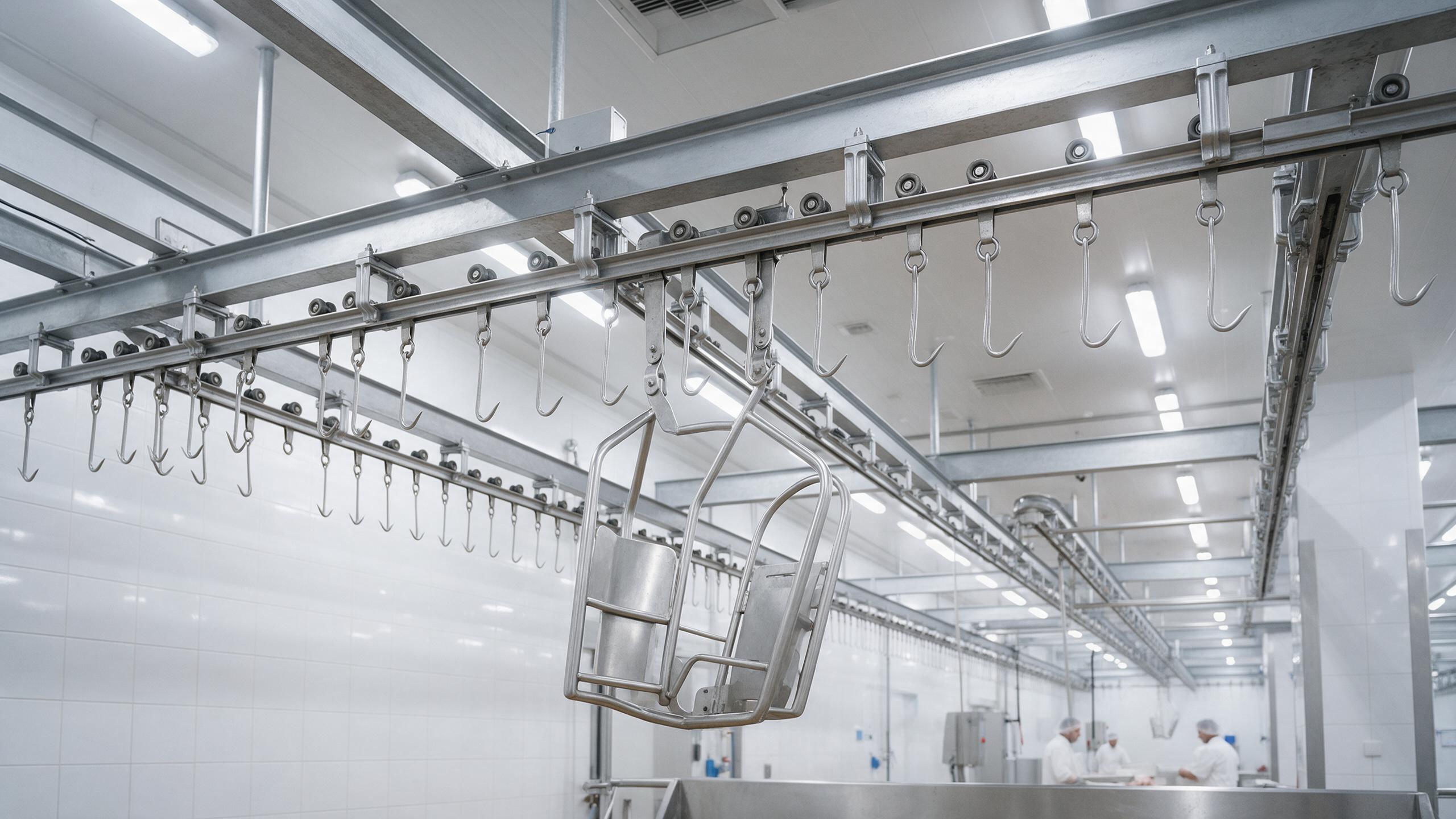
Bleeding rail length, line speed and discharge point must be calculated together. A rail that is too short for the required interval creates a conflict between production speed and compliance. A rail that is unnecessarily long increases building cost and product exposure. The correct length is a process decision based on the approved interval, normal throughput and peak load.
| Design issue | Risk if ignored | Control to define |
|---|---|---|
| Bleeding rail length | Dressing starts before the approved interval is complete | Required time, rail speed, supervisor verification and record |
| Slaughter access | Operator cannot make the required action safely or consistently | Restraint type, platform height, lighting and worker position |
| Animal handling | Stress, injury or delayed restraint | Race design, non-slip floor, training and welfare checks |
| Knife control | Contamination, delay or ineffective cut | Sharpness check, sterilization, spare knives and replacement rule |
Post-Slaughter Dressing and Hygiene
Once the animal has been slaughtered and bleeding is complete, the line moves into dressing. The change in task does not remove the need for control. Hides and skins are major sources of contamination. Heads, hooves and digestive contents need separate routes. Carcass surfaces should remain protected from floor splash, dirty tools and worker clothing.
A hygienic line uses clean and dirty zones as a design principle, not as colored paint on the floor. The physical path of the animal, hide, offal and carcass should make cross-contact difficult even when production is busy. Where a shared area cannot be avoided, the plant should define a validated cleaning or separation procedure and make it visible in the layout and training.
Product Identification and Traceability
Traceability allows the plant to connect an animal or lot to the carcass, offal, approved product and rejected material. Identification should remain readable as the product moves from the bleeding rail through evisceration, inspection, splitting, weighing and chilling. Tags, hooks, trays and electronic systems can all be used, but the plant must train workers to maintain identity at every transfer point.
Records should show who performed the process, what checks were completed, what happened to non-conforming product and how cleaning was verified. The record format should match the actual line layout. A form that asks workers to record a station that does not exist is a sign that the system was copied rather than designed.
Operator Training and Daily Verification
- Animal reception and welfare checks
- Restraint and emergency release
- Stunning policy or no-stun procedure
- Approved slaughter method and personnel authorization
- Knife inspection, sterilization and replacement
- Bleeding time and verification
- Hygienic dressing and tool control
- Product identification and traceability
- Cleaning, corrective action and recordkeeping
Equipment That Supports the Process
For cattle, the main equipment may include a race, head restraint, rotary killing box, bleeding rail, hide puller, platforms, evisceration equipment, splitting saw and chilling system. For sheep and goats, a V-restraint or cradle, bleeding rail, skinning equipment, evisceration station, inspection rail and chilling system are common. The exact scope depends on capacity and automation level.
Review the halal slaughterhouse equipment overview, halal cattle slaughter line and halal sheep and goat slaughter line pages for equipment-level detail. When comparing quotations, check not only the machine list but also how the supplier connects the process, cleaning and documentation.
Common Project Mistakes
Choosing equipment first
The plant buys a restraint or stunner before the authority has approved the method or parameters.
Short bleeding rail
Production pressure pushes dressing before the required bleeding interval is complete.
Poor knife access
The operator has no practical sterilization point, so compliance depends on informal practice.
No product identity
Carcasses and offal lose their link during inspection, splitting or transfer to the chiller.
Records copied from another plant
Forms do not match the actual stations, making verification unreliable and difficult to audit.
No religious review
The authority is contacted only after construction, when layout changes are expensive.
Frequently Asked Questions
Is stunning allowed in a halal slaughter line?
This depends on the authority and the current standard. Some allow reversible stunning under conditions, while others do not. Obtain written guidance before selecting equipment.
Can the same line process cattle and sheep?
A plant may have separate areas or lines for different species. Combining them may require different restraint, rail heights, tooling and cleaning procedures. The feasibility should be reviewed case by case.
How long should the bleeding rail be?
The rail must provide the approved bleeding interval at the actual line speed, including realistic peak conditions. It should be calculated from the process requirement rather than copied from another project.
Who is responsible for halal compliance?
The operating company is responsible for the process and management system. The certification body reviews and approves the scope. Zhengye provides equipment and technical documents that support that system.
Does the guide replace local religious advice?
No. It is a technical preparation guide. Local authorities, religious advisers and accredited certification bodies must confirm the requirements that apply to your site.
Translate requirements into a practical line
Send the animal type, capacity, authority, stunning policy and building plan. We will map the equipment, rail and documentation questions that need to be resolved before fabrication.