
Philippines Slaughterhouse Equipment | Pig, Cattle and Sheep
NMIS-Oriented Slaughterhouse Equipment in the Philippines
Philippine projects often combine pig and cattle processing, local inspection requirements, island logistics and the need to upgrade an existing facility without stopping market supply. Some buyers also require sheep or goat equipment for regional demand.
Zhengye supplies pig, cattle and sheep slaughter line equipment and can prepare a scope around the site, capacity, building and intended inspection or accreditation path. Confirm current NMIS and local requirements with the relevant authority.
Slaughterhouse Equipment Bangladesh | Cattle, Goat and Sheep
Slaughterhouse Equipment for Bangladesh Cattle and Goat Plants
Bangladesh combines a very large Qurbani peak with year-round city meat supply, so a plant is judged on how it behaves in the ten days around Eid-ul-Azha as much as on a normal Tuesday. Lines are usually cattle and goat, often in the same compound, with chilling added in stages.
Zhengye supplies cattle, goat and sheep slaughter equipment sized for that pattern, with the electrical scope set for 220/380 V 50 Hz and installation planned around monsoon access and load shedding.
Design for the peak, not the average
A plant that kills 60 head a day in normal trade may face several hundred in the Eid week. Extra lairage, a second bleeding position and rented chilling space are cheaper than a permanently oversized line — but the layout has to allow them from the start.
Why Slaughterhouse Equipment in Bangladesh Is Specified Differently
Slaughterhouse equipment in Bangladesh is usually bought by a private plant, a city corporation contractor or a cooperative, and each has a different idea of capacity. The private plant wants throughput and a chilled product for hotels and supermarkets. The city corporation wants hygiene and volume at the lowest operating cost. A cooperative wants a line its own staff can maintain.
The equipment answer differs in each case, but three facts are shared. Cattle and goat are normally processed in the same building on different shifts. Ambient temperature and humidity are high for most of the year, so chilling and draining take longer than a European layout assumes. And the Qurbani season creates a demand spike that no line is designed to run at for twelve months.
We therefore quote a base line for normal trade and a separate seasonal plan: additional lairage pens, a temporary bleeding position, hired cold storage and a night shift. That is more useful than a single oversized number, and it is what the cost model is built to compare.
Licensing and Certification Path
| Layer | Who deals with it | Effect on the project |
|---|---|---|
| Environment clearance | Department of Environment | Effluent treatment, odour control and site classification decide whether the plant can operate at the chosen location. |
| Slaughterhouse operation | City corporation or municipality, with the Department of Livestock Services | Premises approval, veterinary inspection and movement of animals. |
| Food safety and standards | BSTI, for products inside its mandatory certification list | Product testing and marking where applicable; industrial machinery is largely outside the list but should be confirmed. |
| Halal certificate | Islamic Foundation Bangladesh (IFB), and separately BSTI | Slaughter method, supervision and records; export markets differ on which body they accept. |
| Import of the equipment | Importer of record, through an irrevocable L/C | Documentation, duty and clearance; the buyer is the importer, not the manufacturer. |
Bangladesh currently runs two halal routes: the Islamic Foundation, which has issued export halal certificates since 2007 and is recognised by JAKIM, and BSTI, which began issuing its own certificates in 2022 and operates a national halal laboratory. Exporters have reported duplication and cost from the overlap. The practical advice is to ask your buyer which certificate their customs authority accepts before the line is specified, because supervision arrangements on the kill floor follow from that answer.
Equipment import is a separate track. Most slaughter machinery is not in BSTI’s compulsory list, but the importer should confirm the HS code position before shipment, and duty on machinery has historically ranged from about 1% to 25% depending on category, with a different regime inside an export processing zone.
Typical Equipment Scope
Lairage and receiving
Unloading ramp, holding pens with a Qurbani expansion area, inspection race and animal washing point.
Restraint and bleeding
Cattle restrainer, goat and sheep restrainer, bleeding rail with trough, knife steriliser.
Hide and skin
Dehiding platform or puller, hide salting area, goat skin table with separate drainage.
Evisceration
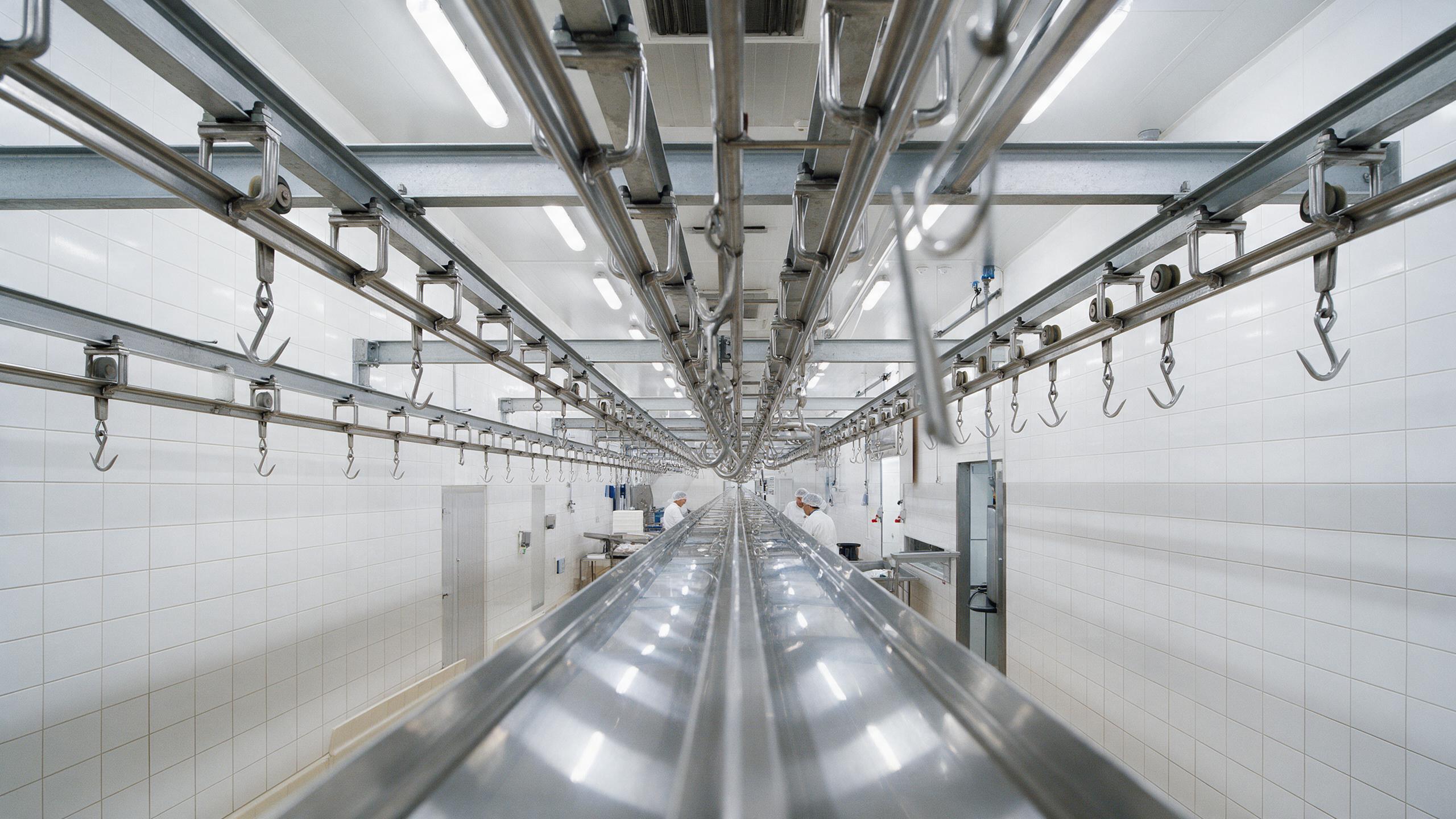
Viscera table, offal trays, paunch handling and condemned-material bin route.
Splitting and chilling
Splitting saw, rail switch, weigh station, chiller with rail or tree trolleys.
Dispatch and by-products
Cutting and packing room, cold store, bone and fat handling, rendering or disposal plan.
Capacity and Seasonal Planning
| Project type | Normal day | Seasonal peak | What changes |
|---|---|---|---|
| City supply plant | 40–120 cattle | 200–400 cattle | Extra lairage, second bleeding position, hired chilling |
| Goat and sheep plant | 150–600 head | 600–1500 head | Shackle pitch, skin tables, more operators |
| Mixed plant | 60 cattle + 200 goat | 200 cattle + 800 goat | Shift separation and separate offal routes |
| Export-oriented plant | 100–300 cattle | flat | Boning room, blast freezer, cold store, halal supervision |
Tell us the normal day and the Eid day separately. A line quoted only against the peak will be idle for eleven months; a line quoted only against the average will fail in the week it matters most. The middle answer is a base line plus a documented seasonal surge plan.
Chilling is normally the real constraint in Bangladesh. A carcass that cannot reach below 7 °C within the required time cannot be sold as chilled meat, whatever the kill floor can produce. We size the chiller against the peak kill, and if that is uneconomic we say so and propose a two-stage chilling or a blast chiller plus holding room instead.
Power Supply, Voltage and Load Shedding
| Item | Bangladesh |
|---|---|
| Single-phase supply | 220 V, 50 Hz |
| Three-phase supply | 380 V, 50 Hz, 3-phase 4-wire |
| Wall sockets in common use | Type A, C, D, G and K, often mixed within one building |
| Motors and drives | 380 V three-phase, 50 Hz |
| Grid behaviour | Frequent short outages and voltage dips; generator or IPS backup is normal |
- Motors, starters and VFDs are set for 380 V / 50 Hz, with control circuits on a 220 V transformer.
- The panel includes phase-failure, under-voltage and overload protection; single-phasing is a common cause of motor failure.
- A generator changeover is planned at the panel, with an interlock so mains and generator cannot be paralleled by mistake.
- Critical loads — chiller, cold store, control system — are listed separately so the generator is sized for them, not for the whole plant.
- Chiller and cold store controls are set to restart in sequence after an outage, because simultaneous restart trips a small generator.
- Terminals, glands and enclosures are selected for high humidity; IP55 for wash-down areas and anti-condensation heaters in the panel.
If the site has no generator and no reliable supply, the honest answer is that a chilled-meat business is not viable on grid power alone. We will still quote the line, but the project brief should include the backup power budget, because it is part of the plant cost and not an optional extra.
Installation, Monsoon and Site Access
Most equipment reaches Bangladesh through Chittagong and then travels by road to Dhaka, Khulna, Rajshahi or Sylhet. Module sizes are planned so that the largest crate fits a standard trailer and can be handled by the crane or chain block available at site. Where the access road floods, we ship in smaller modules and assemble on site rather than sending a single welded frame that cannot be moved.
- Site survey before fabrication: door widths, ceiling height, floor level and the route from truck to building.
- Rails and supports packed separately so civil work can proceed while the machinery is in transit.
- Electrical panels shipped with a wiring diagram and a spare-parts list in English.
- Installation supervised by our engineer for alignment, rail levelling and commissioning; local fitters do the bulk work.
- Water storage sized for a full shift, plus a separate potable line for knife and hand wash.
- Drainage and effluent route agreed before the floor is cut, particularly where the plant shares a boundary wall.
Monsoon raises two practical issues: condensation on chilled surfaces and water entering the lairage. Insulation thickness on chilled rooms, door seals and a covered lairage are worth specifying at the design stage rather than solving later with a dehumidifier.
Heat, Humidity and Water
A Bangladesh kill floor is hot and wet for most of the year. Air movement matters more than air temperature in the lairage, and the chiller load has to be calculated with carcasses entering warm. We ask for the local summer maximum and the incoming water temperature, then size the refrigeration with a realistic pull-down time rather than a catalogue ideal.
Water quality varies widely between deep tube wells and municipal supply; iron and hardness are common. Send a water analysis with the enquiry. High iron stains stainless and clogs nozzles, and hardness scales the hot-water circuit, both of which show up as maintenance cost in the second year.
For plants near rivers, the effluent route and the flood level of the site are worth checking early. A slaughterhouse that floods loses more than a week of production and usually fails its next inspection.
Upgrade or New Build?
| Situation | Typical move | Constraint to check |
|---|---|---|
| Manual slaughter for city market | Restrainer, bleeding rail, offal handling, floor and drain repair | Building height and drainage falls |
| Existing line with no chilling | Chiller and cold store first, kill floor second | Power capacity and insulation |
| Qurbani-only seasonal operation | Simple lairage, bleeding and skin handling, rented chilling | Site access and temporary water supply |
| Export ambition | Segregated flow, boning room, blast freezer, halal supervision | Certification path and importer requirements |
In Dhaka and other dense cities, the building is usually the fixed constraint. Rail height, ceiling clearance and the drain position decide what can be installed, so the first step is a measured survey rather than a quotation. Send photographs and dimensions and we will tell you what fits.
What to Send for a Bangladesh Quotation
- Species and split — cattle, goat, sheep, or a mix with percentages
- Normal daily kill and the Eid-ul-Zhaa peak you expect
- City and site type: new building, rented shed, or an existing plant
- Building dimensions, ceiling height and door widths
- Sanctioned electrical load and whether a generator is installed
- Water source and daily volume
- Product form: fresh, chilled, frozen, or live-animal service slaughter
- Intended halal certificate and the buyer market that requires it
The scope template helps you compare two quotations on the same basis, and the build guide sets out the sequence from land to commissioning. If the project is a first plant, the feasibility study page explains what a bank or investor will ask for.
Frequently Asked Questions
Do you supply equipment certified for Bangladesh?
Equipment is built to the specification agreed with you and can be supplied with test certificates, material certificates and CE documentation where relevant. BSTI marking applies to products in its mandatory list; confirm the position for your HS code with your importer.
Can one line handle both cattle and goat?
Yes, on separate shifts with separate dressing areas. Sharing the same floor at the same time is not recommended.
What voltage is the equipment built for?
380 V three-phase and 220 V single-phase, 50 Hz. We add phase-failure and under-voltage protection as standard.
Can the plant run during load shedding?
With a generator sized for the chiller and control loads. We help define the critical load list so the generator is not oversized.
How is the Eid peak handled?
With additional lairage, a second bleeding position, extra operators and rented chilling capacity, planned in advance rather than improvised.
How long is delivery and installation?
Typically 60–90 days for manufacture and shipping, then 3–5 weeks on site depending on the line size and building readiness.
Size the line for the Eid week and the other fifty weeks
Send the species, the normal day, the peak day and your building dimensions. We will come back with a base line, a seasonal plan and the utility requirements.